CALLY TRENCH
Art History Talks
Sir Robert Vyner, Lord Mayor of London
(1674-75)
by John Michael Wright
Cally Trench: Art History Talks
|
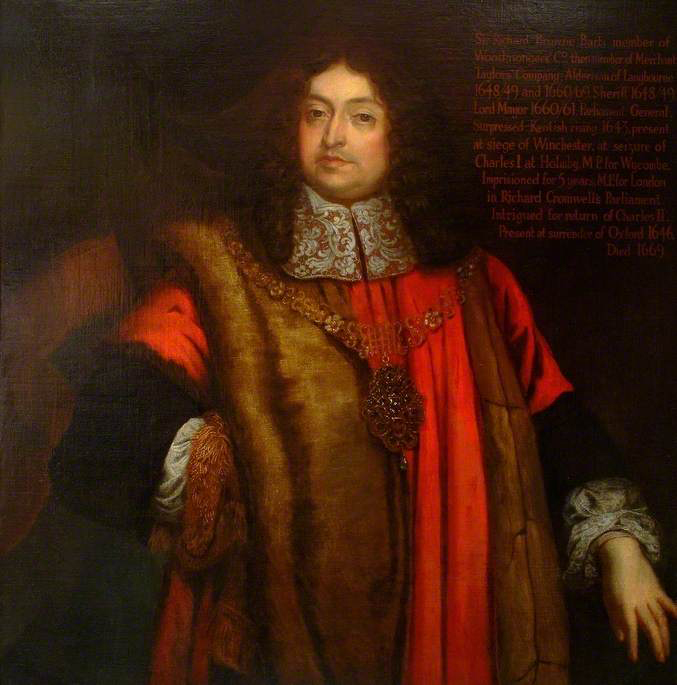
This portrait was purchased by Wycombe Museum with the assistance of the National Art Collections Fund in 1934, because of its supposed connection to Wycombe. It was believed at the time to be of Sir Richard Browne, a Roundhead commander in the English Civil Wars and MP for Wycombe from September 1645 to December 1648. He was also a Lord Mayor of London - in 1660-1661 - and the man in the painting is wearing Lord Mayor's robes and chain, which may be how the confusion arose. Sir Richard Browne In gold lettering to the right of the man's head, there is a short biography of Sir Richard Browne, which reads as follows:
Sir Richard Browne Bart: member of Comparison with known paintings of Sir Richard Browne (such as one at Gawthorpe Hall, Burnley) makes it clear that Wycombe Museum's painting is not in fact of Sir Richard Browne. It was also believed at one time that Wycombe Museum's portrait was associated with Godfrey Kneller, a famous and popular German portrait painter who settled in England in 1676. In terms of dates, this has never made sense. The real subject of the portrait There is a website called ArtUK, which lists and shows almost all oil paintings in public collections, including those at Wycombe Museum. Some 'art detectives' noted in a discussion thread on ArtUK that the face in Wycombe Museum's portrait is essentially identical to that in a portrait in the National Portrait Gallery of a completely different man: Sir Robert Vyner or Viner, who was 29 years younger than Sir Richard Browne.(1) This portrait is The Family of Sir Robert Vyner by John Michael Wright. According to the National Portrait Gallery, the sitters in the portrait are Sir Robert Vyner; his wife Mary, a wealthy widow; Bridget Hyde, Lady Vyner's daughter by her first marriage; and Charles Vyner, the Vyners' only son. The family is shown in the garden of their house, Swakeleys, in Middlesex. The National Portrait Gallery gives a date for this family portrait of 1673. Sir Robert Vyner was, like Sir Richard Browne, a Lord Mayor of London, but in 1674-75, fourteen years after Browne. Given that the National Portrait Gallery dates the family portrait to 1673, and that Sir Robert Vyner was Lord Mayor of London in 1674-75, it is likely that Wycombe Museum's portrait was painted in 1674 or 1675 to commemorate that honour, with the face copied directly or indirectly from the family portrait of a year or two earlier. John Michael Wright (1617-1694) John Michael Wright was unusual in being a successful British portrait painter in the 17th century, when the most famous and popular artists were from continental Europe. Wright was born in 1617 in London, and trained as an artist with the Scottish painter George Jamesone in Edinburgh from 1636. Wright travelled to Rome in the 1640s, and spent ten years there. While he was in Rome, he converted to Roman Catholicism. He was also accepted as a member of the important Accademia di San Luca, which indicates that he had status as an artist in Rome. He settled back in London in 1656. Wright painted a number of works for King Charles II, who was tolerant of Wright's Catholicism. Two such paintings are Astraea Returns to Earth (The Apotheosis of Charles II) of c1660 (Nottingham City Museums & Galleries) and Portrait of Charles II in Garter Robes of 1660-65 (National Portrait Gallery). Wright also painted Catholic nobility. Two of his best-known portraits are of Sir Neil O'Neill of 1680 (Tate) and Lord Mungo Murray of 1683 (National Galleries Scotland). John Michael Wright's career as a court painter ended when King James II was deposed in the 'Glorious Revolution' of 1688, and the Protestant William and Mary took the throne. Wright died in relative poverty in 1694 at the age of 77. One of Wright's most important paintings is his Charles II of England in Coronation robes of c1673-76 (Royal Collection, Throne Room, Palace of Holyroodhouse). The King is shown with his crown, orb and sceptre, wearing ermine and velvet robes, sitting on a throne and looking solemnly straight at us in a very formal pose. This remarkable and dramatic portrait is likely to date to about twelve to fifteen years after the coronation - possibly 1673 or 1676. Interestingly, it is also likely that the commission for this portrait didn't come from the King himself, but rather from Sir Robert Vyner, the man in Wycombe Museum's portrait.(2) Sir Robert Vyner and the Crown Jewels Robert Vyner was born in Warwick in 1631. He moved to London, where he was apprenticed to his uncle Thomas Vyner, a goldsmith and banker. In time, Robert Vyner became a partner in his uncle's business. In 1660, the year of the Restoration of the Monarchy and the year before Charles II's coronation, Robert Vyner bought Swakeleys House, in Ickenham, near Ruislip. He was appointed the King's goldsmith in 1661, and given the job of creating or re-creating for Charles II's coronation the crown jewels (which had been destroyed by order of Parliament after the execution of King Charles I in 1649). Sir Robert Vyner, as the King's goldsmith, is therefore closely associated with a significant number of the crown jewels, which are attributed to him by name. These include the Sovereign's Sceptre with Cross, the Sovereign's Orb, and the Crown of St Edward (all Royal Collection Trust). In 1665, four years after Charles II's coronation, Vyner was knighted by the King, and in the same year he married Mary, the wealthy widow in the family portrait. The following year, in 1666, Vyner was made a Baronet by the King, and he also became an Alderman of the City of London. Vyner also lent money to the King, and, by 1672, the Charles II owed Robert Vyner 400,000 pounds. In that year, the Exchequer stopped all payments in what was known as the Great Stop of the Exchequer, a total repudiation of any debts owed by the King. As a consequence, Robert Vyner went bankrupt. Ultimately, he received an annuity of 20,000 pounds a year from the state, and he managed to hold on to Swakeleys. This financial difficulty didn't stop him from becoming Lord Mayor of London in 1674 - the position in which he is portrayed in Wycombe Museum's painting. If indeed it was Robert Vyner that commissioned John Michael Wright's portrait of Charles II of England in Coronation robes in the 1670s, it may well have been to celebrate his involvement in the creation of the coronation regalia, as well as his association with the King. In the painting, the King wearing the Crown of St Edward, and holding the Sovereign's Orb and the Sovereign's Sceptre with Cross, all of which are attributed to Vyner. Vyner is also believed to have commissioned a still life Regalia of Charles II, attributed to John Michael Wight, c1670 (Museum of London).(3) It therefore appears seems that Sir Robert Vyner commissioned four paintings from John Michael Wright in the 1670s: the family portrait, Wycombe Museum's portrait of Vyner as Lord Mayor, the portrait of the King Charles II in his coronation robes, and the still life of the coronation regalia. Sir Robert Vyner died in 1688. The Royal African Company Sir Robert Vyner was closely associated with the Royal African Company. Originally known as the Company of Royal Adventurers Trading into Africa, it was founded by King Charles II soon after the Restoration of the Monarchy in order to make money. The company was incorporated by royal charter in January 1663, and the King made his brother James, the Duke of York, and future King James II, the Governor of the company. In 1672, the company was reconstituted as the Royal African Company of England, and its main purpose was the trade in enslaved Africans. Sir Robert Vyner was listed as an officer and founding subscriber (that is, shareholder) in this company. The Royal African Company engaged in what is known as the Triangular Trade. Ships left British ports, particularly London, Bristol and Liverpool, transporting manufactured goods from Britain to Africa and trading them for enslaved people. The enslaved people were transported across the Atlantic to the Caribbean, where they were sold to plantation owners. The ships then transported sugar, cotton, tobacco, rum, and other goods back to Britain. According to Slave Voyages (4), a database on the Trans-Atlantic and Intra-American slave trades, European merchants enslaved and transported twelve and a half million African people across the Atlantic, and once they arrived - the ten and three-quarter million people that survived the journey - they were held in perpetual enslavement, as were their descendants, until slavery was abolished in those places. Of those twelve and a half million people, British merchants were responsible for the transporting of three and a quarter million, which is about 38 per cent. Of those three and a quarter million people, nearly 188,000 were transported by the Royal African Company between 1672 and 1731; of these, 38,497 people died en route.(5) Conclusion This painting portrays a man who was involved financially, as both an officer and a subscriber of the Royal African Company, in the Trans-Atlantic trade in enslaved African people. Robert Vyner had no connection with High Wycombe, and the portrait was acquired in 1934 under a misapprehension as to the identity of the man in the painting. While the painting itself has merit and is by, or at least from the studio of, a well-respected 17th-century painter, John Michael Wright, it has no local connection. Consideration is being given by Wycombe Museum as to whether the painting should be de-accessioned, or retained and contextualised. It has been in Wycombe Museum's collection for ninety years, and the story of its purchase under a misapprehension and the revelation as to its true identity can be seen as part of the history of the Museum. Its retention would also allow for aspects of 17th-century history to be discussed. Cally Trench, August 2025 This a summary of Wrong Sitter, Wrong Artist: Why is there a slave trade investor on the Art Gallery wall? A discussion of John Michael Wright's portrait of Sir Robert Vyner, an illustrated Art Collection talk given by Cally Trench at Wycombe Museum on 28th November 2024 and 9th February 2025. Notes
discussions/could-this-portrait-be-the-work-of- john-michael-wright-16171694 [accessed 3/1/24] |