CALLY TRENCH
Art History Talks
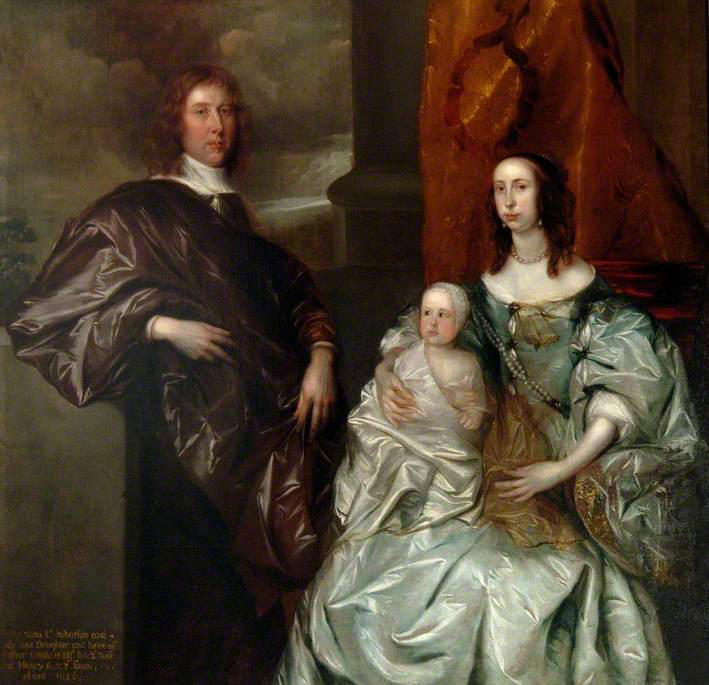
Lord Wharton, Lady Wharton
and their son Henry (c1656)
by an unknown artist
Cally Trench: Art History Talks
|
This large triple portrait shows Lord Wharton with his second wife (Jane Goodwin) and their youngest son, Henry. Lord Wharton and his family are well-documented, but it is not known who the artist is. There is an inscription at bottom left, in gold paint, which reads: 'Philip, now. Ld. Wharton and Lady Jane Daughter and heire of Arthur Goodwin Esq. his 2nd. wife and Henry their 3rd. Sonne, about 1656.' This inscription is typical of the paintings in Lord Wharton's art collection, but these inscriptions were added much later - in the 1670s, probably around 1677 - and so the dates cannot be entirely relied on.(1) According to online family history websites, baby Henry was born in 1657. If this is true, then the picture cannot have been painted before that year. Lord Wharton (1613-96) Philip Wharton, 4th Baron Wharton, was a Puritan and a friend of Oliver Cromwell's. He was also an aristocrat, a wealthy landowner, and an art collector. Lord Wharton was born in 1613. He studied at Exeter College, Oxford, and then travelled to the Hague, to the court of the Protestant Prince of Orange. Lord Wharton married Elizabeth Wandesford in 1632 and had three children: Philadelphia, Christopher and Elizabeth. After Elizabeth's death, Lord Wharton married again in 1637. His second wife was Jane Goodwin, whose father Arthur Goodwin, had been MP for Wycombe in the 1620s, and was himself a Puritan. In 1643, Jane Goodwin inherited from her father substantial estates in Buckinghamshire - in Wooburn, Waddesdon, Winchendon, and Weston. She was described by her father as his 'Honest Deere Jenny'. Lord Wharton and the second Lady Wharton had seven children: Anne (born in 1639), Margaret, Thomas, Goodwin, Mary, Philadelphia, and Henry. Henry is the baby in Wycombe Museum's portrait. Lord Wharton sat in the House of Lords and was a supporter of the Puritans against demands for money from King Charles I. In 1642, Lord Wharton was made Lord Lieutenant of both Lancashire and Buckinghamshire. In the Civil War, he commanded a regiment of foot soldiers. There is a story that when fleeing from the Battle of Edgehill (in October 1642), he hid in a saw pit. He was afterwards given the nickname 'Saw-Pit Wharton'. Later, he opposed the execution of King Charles and refused a seat in Oliver Cromwell's upper house. Lord Wharton accepted the Restoration of the Monarchy in 1660, but opposed the increasing clamp-down on religious freedom. He married for a third time in 1661 and had another son, William. Wharton spent time in prison in 1677 for claiming that Parliament had been adjourned illegally by King Charles II. He accepted James II as King without much enthusiasm, and later the 'Glorious Revolution' in 1688, which brought William and Mary to the throne, with rather more enthusiasm, and he was appointed to the Privy Council. He died in 1696 at the age of 83. Henry Wharton died in Ireland in 1689 at the age of about 31. He was a soldier fighting against the Jacobites, and died of illness in Dundalk Camp, which was notorious for its lack of medical supplies and exposed conditions. Lord Wharton's collection of paintings by Anthony van Dyck Lord Wharton became the first Englishman after King Charles I to commission a portrait from the great Anthony van Dyck after the artist moved to London in 1632. Philip, Lord Wharton (1632) (Andrew W. Mellon Collection, National Gallery of Art, Washington DC) shows Lord Wharton at the age of 19, looking romantic and Arcadian in a rocky landscape. It is said that Lord Wharton owned the largest number of paintings by van Dyck in a single collection,(2) and he was clearly a great enthusiast for van Dyck's work. Art historian Sir Oliver Millar mentions twenty-three paintings by van Dyck in his 1994 article on Lord Wharton's collection. This collection was shown in a purpose-built gallery in his house in Wooburn, near High Wycombe; nothing of Lord Wharton's house or gallery now remains. Anthony van Dyck painted Lord Wharton's second wife, Jane Goodwin, in 1639. This portrait is at Hellens Manor, Herefordshire (collection of the Pennington-Mellor Munthe Trust). This is the same lady as appears in Wycombe Museum's portrait. Van Dyck also painted a double portrait of Lord Wharton's oldest two daughters from his first marriage: Philadelphia and Elizabeth Wharton in 1640 (State Hermitage Museum, St Petersburg). Attribution of Lord Wharton, Lady Wharton and their son Henry Wycombe Museum's triple portrait Lord Wharton, Lady Wharton and their son Henry cannot be by Anthony van Dyck, as the artist died in 1641, some fifteen years before the date of this portrait. Art historian Sir Oliver Millar comments that: 'the composition and the treatment of the draperies are still strongly influenced by Van Dyck.' However, the painting is clearly by a lesser artist. At one time, it was believed that the portrait had been painted by Peter Lely (1618-1680), which is at least possible in terms of dates, but very unlikely on stylistic grounds. In addition, while there were six Peter Lely portraits in Lord Wharton's art collection, they all date from the 1670s and none is of his family. It has also been suggested that the face of Lord Wharton could be by a different hand from that of his wife and baby; it is said by some to be better painted. However, the substantial and unusual similarities between the two adult faces - especially the very high position of the eyes and the elongated shape of the heads - make it much more likely that they are both by the same hand. These characteristics are common to other portraits by this unknown artist. It appears that Lord Wharton owned six portraits of his family by this unknown artist, all dating from the 1650s - including the triple portrait at Wycombe Museum. Other paintings by the same unknown artist There are small oval portraits of Anne, Margaret, Goodwin, and Mary Wharton, all c1658 (in the collection of the Pennington-Mellor Munthe Trust, but not currently on display at Hellens Manor). These four small oval portraits are all, according to art historian Sir Oliver Millar, by the same hand, and by the same hand as Wycombe Museum's portrait: 'Between the Interregnum and the middle years of the reign of Charles II ... can be placed other family portraits which bear the familiar inscriptions: a group, now in the ... Museum in High Wycombe, of Wharton with his wife and their infant son Henry ... ; and a set of four small oval portraits (probably by the same hand and all inscribed 'about 1658') of four other children, Mary ..., Margaret, Anne and Goodwin ...'. There is also a portrait of about 1656, about the same date as Wycombe Museum's painting, which shows three of the Wharton children: Anne, aged about 17, baby Philadelphia, born the previous year (presumably the older Philadelphia had died), and Thomas, aged about eight. When we compare the faces of the sitters in this triple portrait with Wycombe Museum's portrait, we can see substantial similarities in style and especially in the shape of the head and the high position of the eyes, making it very likely that they are both by the same unknown artist. It was suggested in 2022 by the auction house Deweatts that this triple portrait of Anne, Philadelphia and Thomas Wharton was painted by Joan Carlile, an English portrait painter (born in 1606). However, the style of known portraits by Joan Carlile does not correspond with the style of the Wharton portraits. There are therefore six paintings in total by this unknown artist: the four small oval portraits of Mary, Margaret, Anne and Goodwin, the triple portrait of Anne, Philadelphia and Thomas, and Wycombe Museum's portrait, all painted in the 1650s. This makes it clear that Lord Wharton made a conscious choice to commission these works; the Museum's portrait is not a one-off. All of these works show the influence of Anthony van Dyck, and it may be that Lord Wharton, who was clearly an enthusiast for van Dyck's work, specifically asked the unknown artist to emulate the work of that great artist. Lady Wharton There are noticeable similarities between the face of Lady Wharton in Wycombe Museum's portrait and that painted of her by Anthony van Dyck some eighteen years earlier. The main difference lies in the shape of the face; the face in Wycombe Museum's painting is longer and more oval, and the eyes are in the oddly high position characteristic of this artist. The similarities are perhaps of the kind that might be expected from a copy, and which might be unusual in two portraits painted 18 years apart from life by two different artists. It is therefore not inconceivable that the portrait of Lady Wharton in Wycombe Museum's painting was copied - not entirely well - from the earlier portrait by van Dyck. Lady Wharton died in April 1658. So, it is not impossible that this is a posthumous portrait of her, and that her face was copied from the earlier van Dyck portrait, which was, of course, in Lord Wharton's collection. Double portraits There are many double portraits by Anthony van Dyck (and by Peter Lely) that may have acted as models for the unknown painter of Wycombe Museum's portrait. In these, the two figures are usually placed against different backgrounds - typically, there is a curtain behind one sitter, with a column and landscape behind the other. For example, in Anthony van Dyck's famous portrait of Charles I and Henrietta Maria with their two eldest children, Prince Charles and Princess Mary of 1632 (Royal Collection Trust), the Queen is set against a background of drapery, while the King is set against a column, landscape and sky. Linkages between the main two sitters is achieved through the diagonal angling of arms, fabric, and the dog. Wycombe Museum's portrait follows the same pattern of the man and the lady standing against different backgrounds: Lady Wharton is placed against drapery, and Lord Wharton against the sky, with a pillar between them. There are diagonal linkages: Lord Wharton's right hand points directly at Lady Wharton's left hand, with a fold in the drapery of the baby acting as another link. Condition of Lord Wharton, Lady Wharton and their son Henry A conservation and treatment report of May 1992 described the condition of the painting before restoration: 'The harshness of the cleanings received [i.e. previously] by the painting is witnessed by the reduction of Lady Wharton's chiffon scarf to mere golden lines, and of her bodice to the dead colouring. Over most of the painting the final glazes and paint are missing. ... Almost nothing remains of the 'landscape' situated between Lord Wharton and the column. ... Originally Lady Wharton would have had a chiffon scarf flowing over her shoulder, secured by the brooch ... almost nothing remains of this ...' So, when we look at the painting, especially the background, we need to consider that it would have looked a lot more accomplished originally. Conclusion This is a characterful portrait of Lord Wharton, his second wife (Jane Goodwin) and their baby Henry by an unknown artist. It would be fascinating to know who painted it and the other five portraits attributed to the same artist. It emulates the work of Anthony van Dyck in its style and composition, but has a character and charm all of its own, perhaps precisely because of the oddity of the elongated heads and high eyes. Cally Trench August 2025 This is a summary of half of Lely or not Lely: 'Moses Tryon' and 'Lord Wharton and family', an illustrated Art Collection talk given by Cally Trench at Wycombe Museum on 12th May 2024 and 5th September 2024. Notes(1) 'Philip, Lord Wharton, and His Collection of Portraits'. Author: Oliver Millar. Source: The Burlington Magazine, Aug., 1994, Vol. 136, No. 1097 (Aug., 1994), pp. 517- 530 Published by: (PUB) Burlington Magazine Publications Ltd. Stable URL: https://www.jstor.org/stable/886229 [accessed 19.9.26](2) Oliver Millar, Van Dyck in England, National Portrait Gallery, 1982. Page 32. |