CALLY TRENCH
Art History Talks
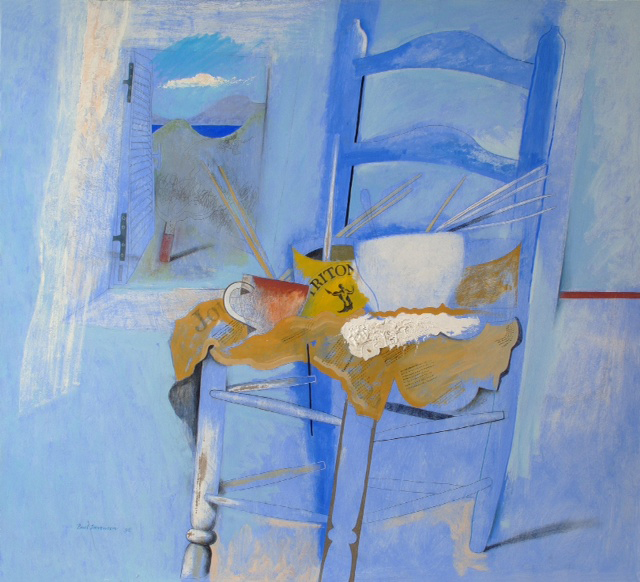
The Blue Chair (1992)
by Paul Stevenson
Cally Trench: Art History Talks
|
This painting shows a blue chair with objects placed on it, in a room, with a landscape visible through the open window. It crosses genres, being a still life, an interior, and a landscape. On the chair, we can see an old yellowing newspaper, a mug, two pots - one white, and one marked 'Triton' - with what look like sticks protruding from the pots and mug. There is a patch of white textured paint on the newspaper. The newspaper title starts JOU, so we can assume that it is the first three letters of 'JOURNAL', and that we are looking at a French newspaper, although there may also be a pun here, in that 'jou' means 'play' in French. If we look at the window, we can see that there is a white curtain blowing in the wind, a blue wooden shutter and a view on to a tree - drawn in graphite - mountains, the blue sea, and then more mountains, and finally the blue sky. The painting is in oil on board, with some graphite marks. Paul Stevenson wrote: 'I Lay great emphasis on the relationship of the marks & quality of paint and pencil to the support ... in my case mostly a variety of hardboard. Like early Icons which I admire, my hard board is often carved into or raised in relief. ... I like my paint to show progress and time - the patina of Frescoes in Italian churches or the texture of archeological finds.'(1) Paul Stevenson (1926-2009) Paul Stevenson was born in Plymouth in 1926, and moved with his parents to North London when he was a child. He studied architecture at what was then the Northern Polytechnic (now the University of North London) from 1943 to 1945. Stevenson was taught by, and influenced by, Cecil Stephenson, an abstract painter. Norbert Linton, who wrote an essay about Paul Stevenson in 2002, commented: 'That the young man should have met this charismatic artist when seeking instruction in architecture goes some way to explaining the interaction of architectural forms and principles, in two and three dimensions ... in Stevenson's paintings and reliefs. ... In a memoir of his teacher Stevenson wrote in 1995, we read of Bauhaus methods, of a small Nicholson abstract brought into the school, or a Piranesi drawing ....'(2) Paul Stevenson did military service from 1945 to 1948 at Sandhurst, and then in the Middle East, including Jerusalem. He became aware of Cycladic art while on leave in Cyprus. After demob, Stevenson studied at St Martin's School of Art in London. In 1951, he completed a teaching course, and also 'renewed his childhood acquaintance with the British Museum: a very formative experience'.(3) From 1952 until his retirement in 1984, Paul Stevenson taught visual studies at what is now Buckinghamshire New University - teaching three-dimensional design students. As part of his teaching practice, Paul Stevenson wrote a series of lectures on drawing in which he refers to human beings as 'binocular bipeds' and the effect of having 'two eyes in the front of our head, carried five foot something above the ground'.(4) Stevenson exhibited widely, including in the John Moore's exhibition in 1959, and in London, Oxford, Reading, Southampton, Cheltenham, St Ives, Aylesbury, West Wycombe, Brighton, Broadway, Cambridge, Burford, and Great Missenden. He visited Florence, Siena, Assisi and Orvieto in 1984. He visited Treboul in Brittany and St Ives in Cornwall, where boats became a theme. In the 1980s and 1990s, he exhibited with the Michael Parkin Gallery. He also visited Malta, Venice, Barcelona, and the Pyrenees. Paul Stevenson died in 2009. Influence of ancient and modern art An exhibition at the ICA in London in 1948, entitled 40,000 Years of Modern Art, made juxtapositions between ancient and modern art, such as Cycladic sculpture and works by Henry Moore. For Paul Stevenson, 'this made the connections he had been looking for quite clear.' He wrote about himself: 'He has always looked for the common language in Art, that would link the past with the present.' Stevenson was interested in ancient architecture, especially post and lintel architecture, the archetypal structure of uprights and horizontal beams. He wrote: 'post lintel Structures fascinated me so also megalithic buildings - Stonehenge, Karnack, New grange'. Stevenson saw the Wright Brothers 'Flyer' biplane as essentially a post and lintel structure: 'a flying temple, our 20th century equivalent of Stonehenge', and that 'Concord proved to be instantly recognisable as a beautiful form, a summation of the amazingly rapid development of flight and therefore our Parthenon.'(5) Stevenson made this connection explicit with an exhibition called Flying Temples in 2003 at the Royal Aeronautical Society. Picasso Paul Stevenson was also influenced by Picasso, and particularly by synthetic cubism. He wrote: 'A study of Picasso's work in the Forties lead to a conviction that the synthetic Cubism of Picasso and Braque was the basis of Twentieth Century vision and capable of indefinite development'. Stevenson wrote about 'Cubism with collage, offering me the opportunity to launch forays into the 'real' depth of relief'. Picasso's collage Still life with Chair Caning of 1912, a famous example of synthetic cubism, incorporates elements of the real world - the rope around the outside is actual rope - and also reproductions of the real world - the 'caning' is oil cloth printed to look like caning - as well as oil paint. The collage includes text, the letters J O U, the same as we can see in Stevenson's The Blue Chair. The carapace Many of Paul Stevenson's paintings were themed around what he called a 'carapace', a kind of container for the human body, or something that works in partnership with the human body, such as a small boat, a spacesuit, a small aeroplane, or a chair. Paul Stevenson made a number of paintings concerned with Douglas Bader, the famous RAF wartime fighter pilot, who continued to fly despite losing both his legs in 1931; these include Icon Flyer of 1978 and Into the Carapace (Douglas Bader) of 1980. Stevenson 'spent a day in the cockpit of a Spitfire in the Museum at Hendon, drawing. The space was tight and the aluminium skin seemed thin and vulnerable, but also very closely identified with Bader's legs. I wanted to show this relationship by painting his legs with aluminium paint ...' In Stevenson's White Carapace Trio and Stonehenge of 1993, which references the 1993 Apollo 7 mission, the carapaces are the spacesuits worn by the three astronauts. Chairs Like aeroplanes and spacesuits, chairs are made to fit the human form. However, whereas Paul Stevenson's planes are always conjoined with a human being, his chairs are unoccupied. Paul Stevenson taught in High Wycombe, so it is not surprising that he was aware of contemporary chair design. He made paintings of designer chairs, including Red Chair (Magistretti) (1989), and two versions of a pair of chairs designed by Fred Scott, both entitled Fred Scott's Supporto, 1990. One of these is in the collection of Wycombe Museum, but not currently on display. Stevenson wrote that: 'The idea that a chair, or a favourite chair, could take on the very personality of its owner became his theme.'(6) He painted a number of chairs belonging to famous people, including Henry Moore's chair - A study in hard and soft forms in Henry Moore's studio (1984) - and Dylan Thomas's chair - Chair, Bottle and Book (Dylan Thomas' writing shed) (1989). The Blue Chair Paul Stevenson wrote about the inspiration for his painting of The Blue Chair: 'The painting by Paul of Picasso's chair was inspired by a chair in a glass case in the Picasso Museum in Paris. It must have come from one of his studios and was now an exhibit in glass case on stair landing. The chair was seen as an aid to part of the creative process. But, in the eyes of another Artist has become a work of Art in its own right telling the story of the Artist Picasso at work.' So, the Blue Chair is not just any chair - it is Picasso's chair, which he used as a table in his studio. The 'sticks' in the two pots are paintbrushes. The Blue Chair is a very blue painting. No only is the chair blue, but so are the floor, the shutter and the walls, the sea and the sky. Picasso had a Blue Period, 1901-1904, when he painted primarily in shades of blue. Given that this is Picasso's chair, it is possible that Stevenson chose to use so many shades of blue as a homage. Conclusion Paul Stevenson identified his own themes as: 'the protective carapace, post and lintel structure, passage of time, archeology, myth and the development of flight’. In this painting, we have the chair as the human-shaped carapace. We see the post and lintel structure of the chair itself. And we are made aware of the passage of time - not only in the reference back to Picasso's use of this chair some forty years earlier, but also in the way that the chair has been re-purposed as a table. The chair has had a life. Cally Trench August 2025 This is a summary of Paul Stevenson: Chairs and Flying Temples, an illustrated Art Collection talk given by Cally Trench at Wycombe Museum on 26th February 2023, 12th July 2023 and 25th January 2024, based on Paul Stevenson - Chairs, flying temples, and why we need to experience the real thing, an illustrated talk given by Cally Trench at Buckinghamshire New University on 1st May 2014. Notes(1) Paul Stevenson, 'Some Notes about My Work', own texts (undated and unpublished) in his folders, made available to the author in 2014.(2) Norbert Linton, 'Essay - Paul Stevenson', 15/4/2002, in Paul Stevenson’s folder of texts and images, made available to the author in 2014.(3) Paul Stevenson, 'A Chronology', own texts (undated and unpublished) in his folders, made available to the author in 2014.(4) Paul Stevenson, foreword to 'The Binnocular Biped: Visual Studies in Drawing', own texts (undated and unpublished) in his folders, made available to the author in 2014.(5) Paul Stevenson, 'Some Notes about My Work', own texts (undated and unpublished) in his folders, made available to the author in 2014.(6) Paul Stevenson, 'The Chair', own texts (undated and unpublished) in his folders, made available to the author in 2014. |